How do you think?
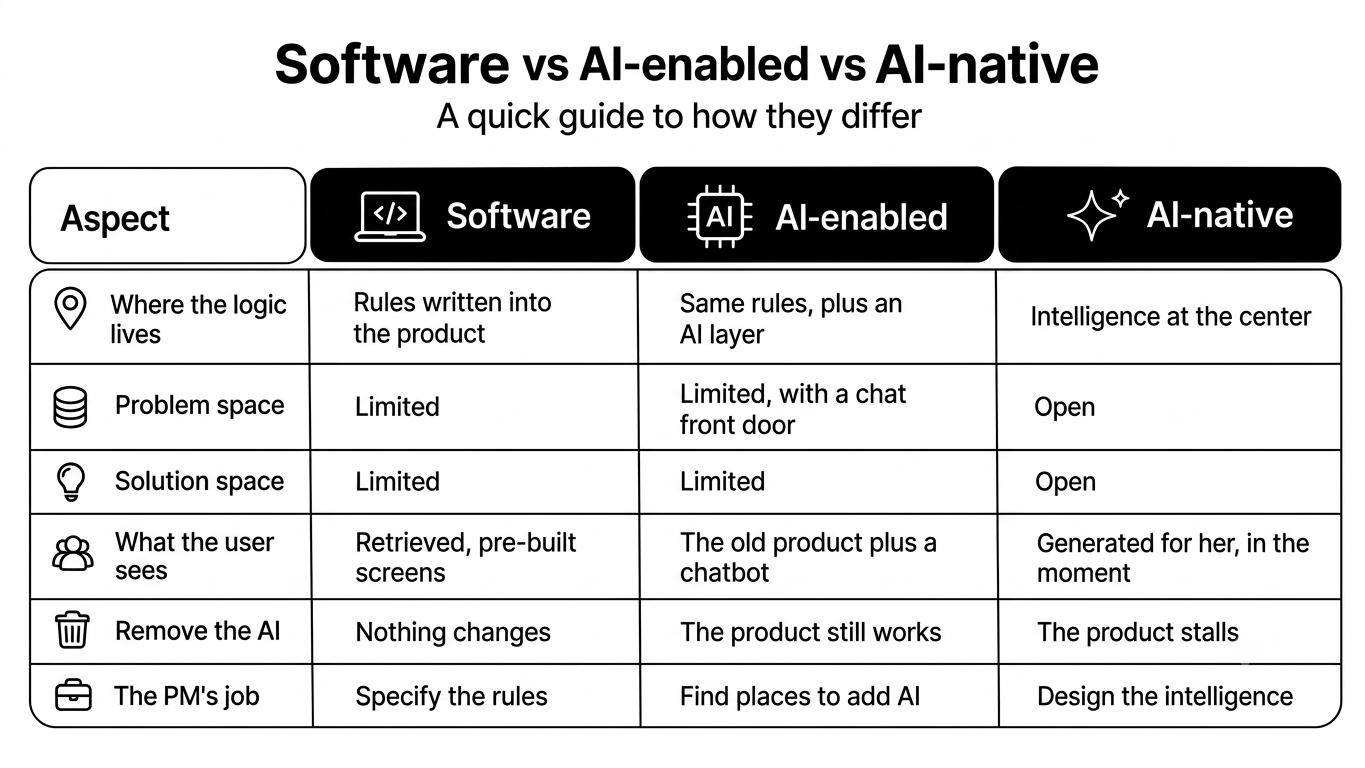
Why most “AI products” are still software, and what it takes to build one that isn’t.
I’ve spent my career building consumer software. When AI arrived, I did what every product person does: I asked, “Where do we add it?”
That question was the problem.
Software is a world of rules
When you build software, you think in a certain way. What does the user need? Which features serve that need? What are the rules? What goes in the database? What workflow runs when she taps this button?
Everything is wired in advance. That gives software two hard limits:
A limited problem space: it only handles the problems you anticipated.
A limited solution space: it only offers the paths you built.
Inside those walls, software is fast, reliable and predictable. Outside them, it’s silent. At its core, software retrieves. It goes to a server, fetches something and shows it, or it runs a workflow someone designed.
AI-enabled is a layer on top
Most “AI products” you see today are AI-enabled. Take Amazon. The marketplace is rule-driven software: catalogs, rankings, filters. On top of it sits a shopping assistant. Travel apps do the same: the same booking engine, plus a chat box that says “Ask our AI.”
Underneath, nothing changed. Same rules, same database, same logic. The AI is a new front door to the old building.
There’s a simple way to spot it. Switch off the chatbot, and the product still works exactly as before.
I understand why companies choose this path. It’s fast, low-risk and easy to demo. But you inherit every old limit. The AI can only reach as far as the rules let it.
The light bulb moment
For a long time I struggled with a question: what does it actually mean to think AI-native?
The answer came when I heard Jensen Huang explain a shift in computing. Traditional computing is retrieval: you press a button, a signal goes out, and you’re shown pre-recorded content. By GTC 2026 he put it in one line: “Computing used to be retrieval-based, now it’s generative.”
That reframed everything for me. In software, a product is a library of pre-made answers. In generative AI, for everything the user does, the AI thinks. It produces tokens, and those tokens are translated into the experience. The interface isn’t fetched. It’s composed for that person, at that moment.
Two tests for AI-native
1. The generation test. For every user action, does an AI think and create the response, or does the system fetch a pre-built one?
2. The removal test. Remove the AI. If the product still works, it’s AI-enabled. If it stalls, it’s AI-native.
One honest note: AI-native products still retrieve facts. Prices, inventory and return policies all have to be fetched. The difference is that retrieval becomes a tool the AI uses, not the product itself.
What this looked like for us: THINGS
We asked: what would shopping look like if every part of it were generated? The answer was five agents that work for you.
Inspector keeps looking for trusted shops, so you only discover sellers worth your time.
Editor generates looks from your body shape and preferences, a feed made just for you, and explains why each item was picked.
ME lets you try on any outfit and see it on you.
Ego is the stylist you chat with. It guides you, teaches you and finds what your wardrobe is missing.
Accountant makes sure you get the best deal, finds the discounts and flags the shipping and return fine print, so there are no post-purchase regrets.
Now run the removal test. Take the AI out of THINGS and there’s no vetting, no personal looks, no try-on, no stylist and no deal analysis. What’s left is a catalog with nothing to say.
We made two more choices. The AI stays invisible: you don’t talk to an agent, you just enjoy its work. And the human always presses Buy.
What changes for the product manager
It took us a year to unlearn software thinking. Here’s what changed:
Stop writing rules. Start writing intent and judgment. You define what good looks like, not every step.
Treat retrieval as a tool. The AI decides when to fetch, and what to do with it.
Evaluation is the new spec. You write rubrics and tests, because the output is never exactly the same twice.
Design for variance. AI is persuasive and unpredictable, like a person. It needs guardrails, personality and taste.
Let the AI disappear. People don’t want to talk to AI. They want the result.
The question to ask
The next time someone shows you an “AI product,” ask one thing: remove the AI. What’s left?
If the answer is “everything,” you’re looking at software with a feature. If the answer is “nothing,” you may be looking at what comes next.
Software retrieves what we built. AI-native generates what you need.