Notes
1. Our Story
Before THINGS, we ran Sweetcouch, a shopping app, for seven years. It reached over 10 million users and was backed by Sequoia Capital.
With THINGS, we wanted to reimagine shopping for an AI-first world.
That required us to unlearn how we had always built software.
Like most people who build software products, we had a software mindset. We thought in terms of needs, innovation, features, rules, UX, databases and protocols. You identified a problem, designed a solution, defined the rules and built the experience around them.
Building AI-native meant unlearning all of that. AI introduces capabilities with no real precedent. You cannot simply take the old way of building products and add a new technology to it. You have to rethink what the product itself can be.
AI-enabled is one thing. AI-native is a different game.
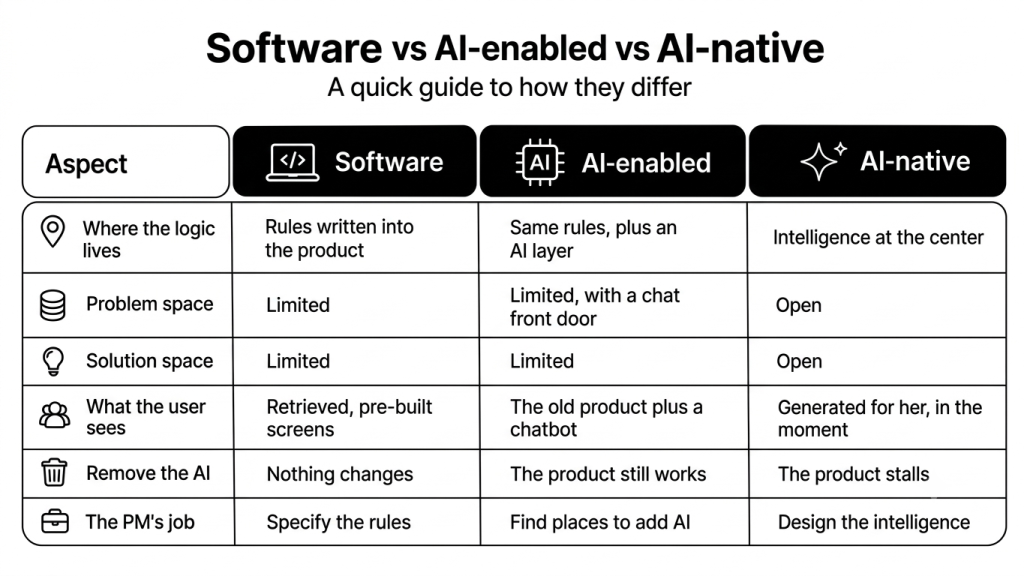
AI-enabled products add AI to an existing software experience. AI-native products embed a powerful, non-deterministic brain into the product itself. Think of Google’s AI Mode as an example of AI being added to an established experience. The distinction is not merely technical; it changes how you approach the entire product.
Traditional software operates within a defined problem space and a defined solution space. AI has neither limit in the same way. It can interpret context, adapt to individual needs and produce outcomes that aren’t entirely predictable in advance. It can also be persuasive and, much like a human, build a relationship with the person using it.
Consumer AI: Save Time or Spend Time?
Most consumer AI products promise to save you time. Shopping is different.
Shopping isn’t just a task to complete. It’s also a way to unwind, explore, discover and enjoy yourself. People often want to spend time shopping, not eliminate the experience altogether.
That shaped how we built THINGS. There had to be no learning curve and nothing nerdy. The interface needed to be simple and fun, with AI diffused through every layer of the experience rather than presented as a technical feature the user had to operate.
Five Experts. One Personal Styling Team.
The result is THINGS: your own team of five AI agents working as your personal stylists.
Inspector vets shops so you discover only trusted sellers.
Editor curates fresh looks for you, explains why they suit you and helps you discover new fashion.
ME lets you try a look on yourself before buying, so you see it on you, not just on a model.
Ego helps you understand your style, follow trends and discover what’s missing from your wardrobe.
Accountant finds the best prices and coupons, and flags shipping costs and return-policy fine print before you pay.
The agents work behind the scenes. You don’t need to see or manage them. You simply enjoy their work, created exclusively for you.
A New Way of Shopping
We believe THINGS is the first AI-native consumer app of its kind. Our ambition is to disrupt shopping the way ChatGPT disrupted search—not by adding AI to the old experience, but by reimagining the experience around AI from the ground up.
In our tests, THINGS beat every other AI app we compared it with globally, both on AI-first principles and on UX.
We’re rolling out in India first, then taking THINGS to the world.
—
—
2. How do you think?
Why most “AI products” are still software, and what it takes to build one that isn’t.
I’ve spent my career building consumer software. When AI arrived, I did what every product person does: I asked, “Where do we add it?”
That question was the problem.
Software is a world of rules
When you build software, you think in a certain way. What does the user need? Which features serve that need? What are the rules? What goes in the database? What workflow runs when she taps this button?
Everything is wired in advance. That gives software two hard limits:
A limited problem space: it only handles the problems you anticipated.
A limited solution space: it only offers the paths you built.
Inside those walls, software is fast, reliable and predictable. Outside them, it’s silent. At its core, software retrieves. It goes to a server, fetches something and shows it, or it runs a workflow someone designed.
AI-enabled is a layer on top
Most “AI products” you see today are AI-enabled. Take Amazon. The marketplace is rule-driven software: catalogs, rankings, filters. On top of it sits a shopping assistant. Travel apps do the same: the same booking engine, plus a chat box that says “Ask our AI.”
Underneath, nothing changed. Same rules, same database, same logic. The AI is a new front door to the old building.
There’s a simple way to spot it. Switch off the chatbot, and the product still works exactly as before.
I understand why companies choose this path. It’s fast, low-risk and easy to demo. But you inherit every old limit. The AI can only reach as far as the rules let it.
The light bulb moment
For a long time I struggled with a question: what does it actually mean to think AI-native?
The answer came when I heard Jensen Huang explain a shift in computing. Traditional computing is retrieval: you press a button, a signal goes out, and you’re shown pre-recorded content. By GTC 2026 he put it in one line: “Computing used to be retrieval-based, now it’s generative.”
That reframed everything for me. In software, a product is a library of pre-made answers. In generative AI, for everything the user does, the AI thinks. It produces tokens, and those tokens are translated into the experience. The interface isn’t fetched. It’s composed for that person, at that moment.
Two tests for AI-native
1. The generation test. For every user action, does an AI think and create the response, or does the system fetch a pre-built one?
2. The removal test. Remove the AI. If the product still works, it’s AI-enabled. If it stalls, it’s AI-native.
One honest note: AI-native products still retrieve facts. Prices, inventory and return policies all have to be fetched. The difference is that retrieval becomes a tool the AI uses, not the product itself.
What this looked like for us: THINGS
We asked: what would shopping look like if every part of it were generated? The answer was five agents that work for you.
Inspector keeps looking for trusted shops, so you only discover sellers worth your time.
Editor generates looks from your body shape and preferences, a feed made just for you, and explains why each item was picked.
ME lets you try on any outfit and see it on you.
Ego is the stylist you chat with. It guides you, teaches you and finds what your wardrobe is missing.
Accountant makes sure you get the best deal, finds the discounts and flags the shipping and return fine print, so there are no post-purchase regrets.
Now run the removal test. Take the AI out of THINGS and there’s no vetting, no personal looks, no try-on, no stylist and no deal analysis. What’s left is a catalog with nothing to say.
We made two more choices. The AI stays invisible: you don’t talk to an agent, you just enjoy its work. And the human always presses Buy.
What changes for the product manager
It took us a year to unlearn software thinking. Here’s what changed:
Stop writing rules. Start writing intent and judgment. You define what good looks like, not every step.
Treat retrieval as a tool. The AI decides when to fetch, and what to do with it.
Evaluation is the new spec. You write rubrics and tests, because the output is never exactly the same twice.
Design for variance. AI is persuasive and unpredictable, like a person. It needs guardrails, personality and taste.
Let the AI disappear. People don’t want to talk to AI. They want the result.
The question to ask
The next time someone shows you an “AI product,” ask one thing: remove the AI. What’s left?
If the answer is “everything,” you’re looking at software with a feature. If the answer is “nothing,” you may be looking at what comes next.
Software retrieves what we built. AI-native generates what you need.